share

Wednesday, October 31, 2012

watercolour


Watercolour drawing of the face of a man to show the appearance caused by very rapid post-mortem decomposition. It was made thirty-six hours after death during the hot weather of the summer of 1893


Watercolour drawing of the face and chest of a man to show the appearance caused by rapid post-mortem decomposition.


Japanese death and decay of a lady of the court

Tuesday, October 02, 2012

Just hanging out


The hanging coffins of the Bo People 

The Bo People known as ‘Sons of the Cliffs’ made coffins, which are stowed in clefts on the vertical rock faces of Southern China.  It is mysterious as to how the heavy coffins were deposited on such steep, inhospitable cliffs. Some of those are coffins are placed on wooden beams projecting out from rock, others are on the rocks themselves. Still others are merely placed in caves, some are suspended on wooden stakes above the ground or stuck into the cliff face.  

They were also called Tu Tian, "Subjugators of the Sky," because it was apparently their perverse nature to "struggle against heaven." In the summer when it was hot, they wore leather coats and warmed themselves by the fire; in the winter, they wore a single sweat garment and carried big fans in their hands.  It is thought that the hanging coffins could prevent bodies from being taken by beasts and also bless the soul eternally.


Why the Bo lived this way and interred their dead on the sides of cliffs remain a mystery; only intermittent mention of them exists in Chinese history, and they eventually disappeared without a trace.

In the Philippines on the Cliffs of Sagada the elderly make their own coffins from hollowed out logs. The body is smoked to preserve for the five day pre-burial feast before being fitted into the tight space of the coffin which often requires breaking the deceased’s bones – after they have been placed in the coffin they are then bought to the mountainside to join their ancestors either suspended on the cliff or placed in a cave.

Don't forget your iPhone!


Paper slaves to take to the afterlife


Since cremation is traditionally uncommon, the burial of the dead is a matter taken very seriously in Chinese society. Improper funeral arrangements can wreak ill fortune and disaster on the family of the deceased.

Chinese funeral rites and burial customs are determined by the age of the deceased cause of death, status and position in society, and marital status. All who die will automatically enter the underworld of Diyu to be judged before either being sent to heaven, to be punished in the underworld, or to be reincarnated. The word ‘hell’ is not to be compared with the western understanding of the word, but rather as ‘Chinese afterlife in general’, a more neutral platform.

Paper objects, such as clothing, jewellery, mobile phones, accessories, cars, lavish models of paper villas with manicured gardens, home interiors, medicine, fancy foods and liquors, cosmetics and others, should be extravagant, luxurious and will most likely be showing a high end brand name of an earthly company; simply speaking: the more expensive- the better. The ancestors will be given all the luxuries that were eluded in life. You can buy banknotes showing the name ‘Bank of Universal’, ‘Bank of Heaven’ or even ‘Bank of Paradise’. Ancestor worship is a religious practice based on the belief that deceased family members have a continued existence, take an interest in the affairs of the world, and possess the ability to influence the fortune of the living.

Preparation for a funeral often begins before a death has occurred. When a person is on his/her deathbed, a coffin will often have already been ordered by the family. A traditional Chinese coffin is rectangular with three 'humps', although it more common in modern times for a western style coffin to be used. The coffin is provided by an undertaker who oversees all funeral rites.

During the wake, the family does not wear jewelry or red clothing (red is the color of happiness). Traditionally, children and grandchildren of the deceased did not cut their hair for 49 days after the death, but this custom is now usually only observed by older generations. It is customary for blood relatives and daughters-in-law to wail and cry during mourning as a sign of respect and loyalty to the deceased. The cries are particularly loud if the deceased has left a large fortune.

During the wake there is usually a group of people gambling in the front courtyard of the deceased's house because the corpse must be "guarded," and gambling helps the guards stay awake during their vigil. This custom also helps to lessen the grief of the participants.

The Chinese believe that seven days after the death of a family member the soul of the departed will return to his/her home. A red plaque with a suitable inscription may be placed outside the house at this time to ensure that the soul does not get lost.  On the day of the return of the soul, family members are expected to remain in their rooms. Flour or talcum powder may be dusted on the floor of the entrance hall of the home to detect the visit.


Paper horse and cart


Paper Iphones, Ipads and computers.


Excavation


Willem De Kooning Excavation  1950

Monday, October 01, 2012

Updated website

New posts coming soon, in the meanwhile I have updated my website www.boosaville.com


Thursday, February 02, 2012

Top five regrets of the dying


Top five regrets of the dying
A palliative nurse has recorded the most common regrets of the dying, and among the top ones is 'I wish I hadn't worked so hard'. What would your biggest regret be if this was your last day of life?
(Susie Steiner from guardian.co.uk, Wednesday 1 February 2012 11.49 GMT)
There was no mention of more sex or bungee jumps. A palliative nurse who has counselled the dying in their last days has revealed the most common regrets we have at the end of our lives. And among the top, from men in particular, is 'I wish I hadn't worked so hard'.
Bronnie Ware is an Australian nurse who spent several years working in palliative care, caring for patients in the last 12 weeks of their lives. She recorded their dying epiphanies in a blog called Inspiration and Chai, which gathered so much attention that she put her observations into a book called  
The Top Five Regrets of the Dying.
Ware writes of the phenomenal clarity of vision that people gain at the end of their lives, and how we might learn from their wisdom. "When questioned about any regrets they had or anything they would do differently," she says, "common themes surfaced again and again."
Here are the top five regrets of the dying, as witnessed by Ware:
1. I wish I'd had the courage to live a life true to myself, not the life others expected of me.
"This was the most common regret of all. When people realise that their life is almost over and look back clearly on it, it is easy to see how many dreams have gone unfulfilled. Most people had not honoured even a half of their dreams and had to die knowing that it was due to choices they had made, or not made. Health brings a freedom very few realise, until they no longer have it."
2. I wish I hadn't worked so hard.
"This came from every male patient that I nursed. They missed their children's youth and their partner's companionship. Women also spoke of this regret, but as most were from an older generation, many of the female patients had not been breadwinners. All of the men I nursed deeply regretted spending so much of their lives on the treadmill of a work existence."
3. I wish I'd had the courage to express my feelings.
"Many people suppressed their feelings in order to keep peace with others. As a result, they settled for a mediocre existence and never became who they were truly capable of becoming. Many developed illnesses relating to the bitterness and resentment they carried as a result."
4. I wish I had stayed in touch with my friends.
"Often they would not truly realise the full benefits of old friends until their dying weeks and it was not always possible to track them down. Many had become so caught up in their own lives that they had let golden friendships slip by over the years. There were many deep regrets about not giving friendships the time and effort that they deserved. Everyone misses their friends when they are dying."
5. I wish that I had let myself be happier.
"This is a surprisingly common one. Many did not realise until the end that happiness is a choice. They had stayed stuck in old patterns and habits. The so-called 'comfort' of familiarity overflowed into their emotions, as well as their physical lives. Fear of change had them pretending to others, and to their selves, that they were content, when deep within, they longed to laugh properly and have silliness in their life again."


Wednesday, January 25, 2012

The Death of Ivan Ilyich


Opisthotonus by Charles Bell

  "From that moment the screaming began that continued for three days, and was so terrible that one could not hear it through two closed doors without horror. At the moment he answered his wife realized that he was lost, that there was no return, that the end had come, the very end, and his doubts were still unsolved and remained doubts.

"Oh! Oh! Oh!" he cried in various intonations. He had begun by screaming "I won't!" and continued screaming on the letter "O".

For three whole days, during which time did not exist for him, he struggled in that black sack into which he was being thrust by an invisible, resistless force. He struggled as a man condemned to death struggles in the hands of the executioner, knowing that he cannot save himself. And every moment he felt that despite all his efforts he was drawing nearer and nearer to what terrified him. he felt that his agony was due to his being thrust into that black hole and still more to his not being able to get right into it. He was hindered from getting into it by his conviction that his life had been a good one. That very justification of his life held him fast and prevented his moving forward, and it caused him most torment of all." 

From 'The Death of Ivan Ilyich 
By Leo Tolstoy   

Monday, January 23, 2012

DIGNITAS

Files at the Dignitas offices in Zurich, where more than 150 Britons have ended their lives. Photograph: David Levene for the Guardian

I never knew there was so much tea involved in death. "Would you like a cup of tea?" Peter Smedley asks Sir Terry Pratchett, before they settle down to talk about dying.


In Terry Pratchett: Choosing To Die, He explores the realities of medically assisted death. Having been diagnosed with a rare form of early onset Alzheimer's disease in 2008, Terry considers how he might choose to end his life as his condition progresses. In a moving documentary he meets those who, like him, would like to control the way they die including a men suffering from degenerative conditions and he is with a British motor neurone sufferer as he carries out an assisted death at the Dignitas clinic in Switzerland.


Dying Together. The Euthanasia of Sir Edward and Lady Downes


"The son of one of Britain’s most respected musicians told yesterday how he wept as he watched his father and mother die hand in hand at the Dignitas suicide clinic in Zurich. Distinguished orchestral conductor Sir Edward Downes, 85, and his 74-year-old wife Joan died from barbiturate poisoning as their children sat with them. Lady Downes had terminal cancer of the liver and pancreas while her husband was nearly blind and increasingly deaf.

Their son Caractacus, 41, said: ‘They drank a small quantity of clear liquid and then lay down on the beds next to each other. ‘They wanted to be next to each other when they died. They held hands across the beds. Within a couple of minutes they were asleep and they died within ten minutes."

A building used by Dignitas for assisted suicides.


"The Dignitas experience: 'It was all a bit scruffy, but it didn't seem to matter" John Larrett  


"We went off to the famous flat in Zurich, which was an ordinary modern block. It was a very nondescript looking place. Some chap who worked for Dignitas introduced himself. They're continually asking the whole time if you want to go through with it, saying it's fine if you want to pull out, even right to the end, when they're mixing up the poison. But no, she was absolutely determined to do it. It wasn't soft lights and soft music, it was all a bit scruffy in a way, but it didn't seem to matter. I can't remember quite what we said to each other in those last minutes, something like, 'Good luck, have a good trip', or,  'Thank you for the happy times we've had'.


The man mixed up this potion. It was quite quick actually. She had this straw and she really sucked it down in a big way. She didn't sip, she really went for it. Within about a minute and a half she was shaking a bit on the bed and I was holding on to her, and then eventually, bang, that was it. I was left sitting there with Diana's dead body for about 20 minutes. It was a bit peculiar. I thought: 'Well, this is it.'

Then we flew back. The flight home was rather odd. I didn't feel bad about it – I felt glad it had happened but pretty empty, really. I was thinking, 'Oh God, and now I've got to carry on with things on my own', which I hadn't really thought about before. We'd left at about nine in the morning and got back about 10 at night. It all happened in one day. Her cousin dropped me off – I remember he had this Jag – and there I was on my own. That was it, finished. I do think about it occasionally. I miss not having Diana around, it's been quite lonely.

But I don't have any regrets about what she decided to do, absolutely no doubt about it at all. I'm delighted that Debbie Purdy won on Thursday. Anything that means that the law can be altered so people with horrible, incurable diseases can end their lives if they choose to is excellent.

guardian.co.uk,  

Saturday, January 21, 2012

Bournemouth Benches

 During a walk on boxing day i saw these blue benches. They had been freshly painted.


Thursday, December 01, 2011

Macbeth

Out, out, brief candle!
Life’s but a walking shadow, a poor player
That struts and frets his hour upon the stage
And then is heard no more; it is a tale
Told by an idiot, full of sound and fury,
Signifying nothing.


Discuss

Wednesday, November 02, 2011

Monday, October 31, 2011

“Don’t look back, keep running”

Remembering death as i was growing up.

This is a selection of videos and images which I remember and how shaped my ideas, made me afraid and inquisitive about death as a child. 

There was a school safety video that has stuck in my memory for being particularly scary. It was one about the railway where the kids football boots get caught on the line as hes crossing the tracks, he gets stuck as a train is coming and his legs get cut off. His sister watches the whole thing, screams and then she doesn't speak again. I was always really affected by the fact that she was so scared that she never spoke again.  I've been trying to find this one for you but no luck here are some other equally chilling ones. Enjoy!

Dark and Lonely Water 


Aids Monolith 1987


The Smoker of the future 


Stay out of the Fridge!
 
Electricity
ET. 

I found ET's death memorable because it is actually a story of resurrection as he comes back to life.   E.T’s health begins to decline, and while Michael and Elliot go out for Halloween with E.T. The next morning Michael finds E.T dying in the forest, and when he takes him to Elliott realizes that he is also dying. Mary, Elliott’s mother, becomes frightened when she discovers her son’s illness and the dying alien, before government agents invade the house. Scientists set up a medical facility in the house, quarantining Elliott and E.T. Their link disappears, and E.T. then appears to die while Elliott recovers. A grief-stricken Elliott is left alone with the motionless alien.
This death is ingrained into the memory of all who watch it the film because the child with his childlike innocence and joys must face the grim realities of death through his friend. As he holds the lifeless corpse of his friend in his arms, we all feel the sadness and loss with him.  

The death of Artex. The Neverending Story

I always remember the death of Artex as a really sad moment of my childhood. It didn't matter how many times i watched it, i always cried. It place in the deadly Swamps of Sadness, that Artreyu must pass in order to see the ancient Morla, the wisest being in all of Fantasia. Arteyu’s passage is hindered though, due to his horse, Artax, who is enveloped by the sadness of the swamps and sinks into the mud. No matter how Atreyu tries to pull his trusty steed out of the mire of dark emotions, he must leave Artax behind, and watch as he sinks into the swamps depths. 

Disney Death
This YouTube video is a compilation on all the best known disney deaths


The death of Daphne in Neighbours

This one gave me nightmares for weeks! I used to watch the Australian series "Neighbours' religiously in my early teens and this death scene of the character Daphne struck me particularly when she came round from her coma said 'des' her husbands name and then tragically slipped away. 


Wednesday, October 26, 2011

Old English poem

Eggs and Marrowbone 
(A traditional folk song from the UK)

There was an old woman in our town
In our town did dwell
She loved her husband dearly
But another man twice as well

She went down to the doctor
To see what she could find
To see what she could find, Sir
To make her old man blind.

"Feed him eggs and marrowbone
And feed them to him all,
And that will make him so darned blind
He can't see you at all."

So she fed him eggs and marrowbone
Fed them to him all,
And that did make him so darned blind
He couldn't see her at all

"So now I'm getting old and blind
And tired of my life
So I'll go and drown myself
And that will end my strife"
"To drown yourself," said she, said she,
"Now that would be a sin.
So I'll go down to the river's edge
And kindly push you in."

The old woman took a running jump
To push her old man in.
The old man he just stepped aside
And the woman she fell in.

She yelled for help, she screamed for help;
Loudly she did bawl.
The old man said "I'm so gol-darned blind
I can't see you at all!"

So she swam along, swam along,
Till she came to the river's brim.
The old man got a great long pole
And pushed her further in.

Now the old woman is dead and gone
And the Devil has got her soul.
Wasn't she a blamed old fool
That she didn't grab that pole?  

Eating eggs and marrowbone
Won't make your old man blind;
So if you want to do him in
Just creep up from behind.


Tuesday, October 25, 2011

fall from grace

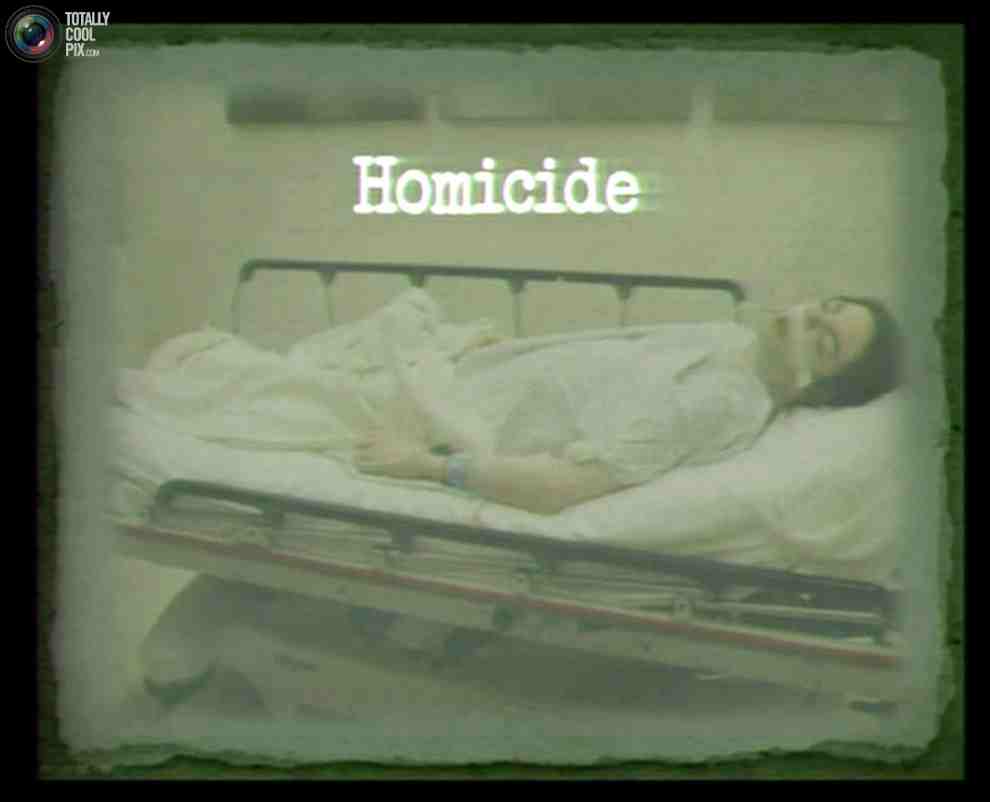
I did an internet search to see how many pictures I could find of Michael Jackson's dead body.